
Nick Bollinger
“Dad talked to me from the moment I opened my eyes, and I can remember conversations all through those sixteen years with him.”
Nick Bollinger’s dad was known to many as a wise and kind man before he died when Nick was sixteen. The writer and broadcaster reckons he’d have the same job had his father lived, but would have found his way there much sooner.
Nick Bollinger’s dad, Con, was widely known for a particular phrase, a greeting. Where most New Zealanders of the time might say, “G’day, how are ya?”, Con proffered a different salutation.
“The first thing he’d say to people was, ‘Are you happy?”’ laughs Nick. “For some that was quite a confronting question. ‘Oh, am I happy? Should I be happy?’”
Nick is a writer, music critic, music show host, and when we spoke was working on a book about how New Zealand music shapes the country’s culture, or, just as likely, how New Zealand culture shapes its music. Nick’s dad, Con, was well-known on the Wellington intellectual scene of the 20th century’s middle decades. He was an English lecturer at Victoria University, a writer and editor, a socialist and progressive thinker, political newspaper producer – a man of many accomplishments
Nick and Con in London 1959
“He asked ‘are you happy” because, existentially, he was happy,” says Nick.
“There was always something funny that had happened, or a piece of music or a book that had elevated him, just as there was always something to be angry about. But he’d channel anger into action – he’d write an article or a letter or organise a meeting.
“He’d ask ‘are you happy’ of his students, of us kids, and of our friends. I was aware when I brought friends home that some came to talk to my dad, not to visit me. Or they’d come to visit me but would end up having long conversations with my father. They would say to me, ‘My dad doesn’t talk to me’, or ‘I’ve never been to a place where the parents actually want to know about my life and how I am’.
“’Are you happy?’ was Dad’s version of ‘how are you’, but he genuinely wanted to know. Some of my friends weren’t very happy and they would tell him, and he was very sympathetic. A couple of my close friends were very depressed when he died.”
About a week before his dad died in June 1975, Con had another question for his son. “Do you notice anything different about me?” he asked after Nick arrived, having walked from his flat up to the family home in the suburb above Victoria University.
“No?” shrugged Nick, then sixteen years old.
“I’ve stopped smoking. I’m not smoking,” his dad answered.
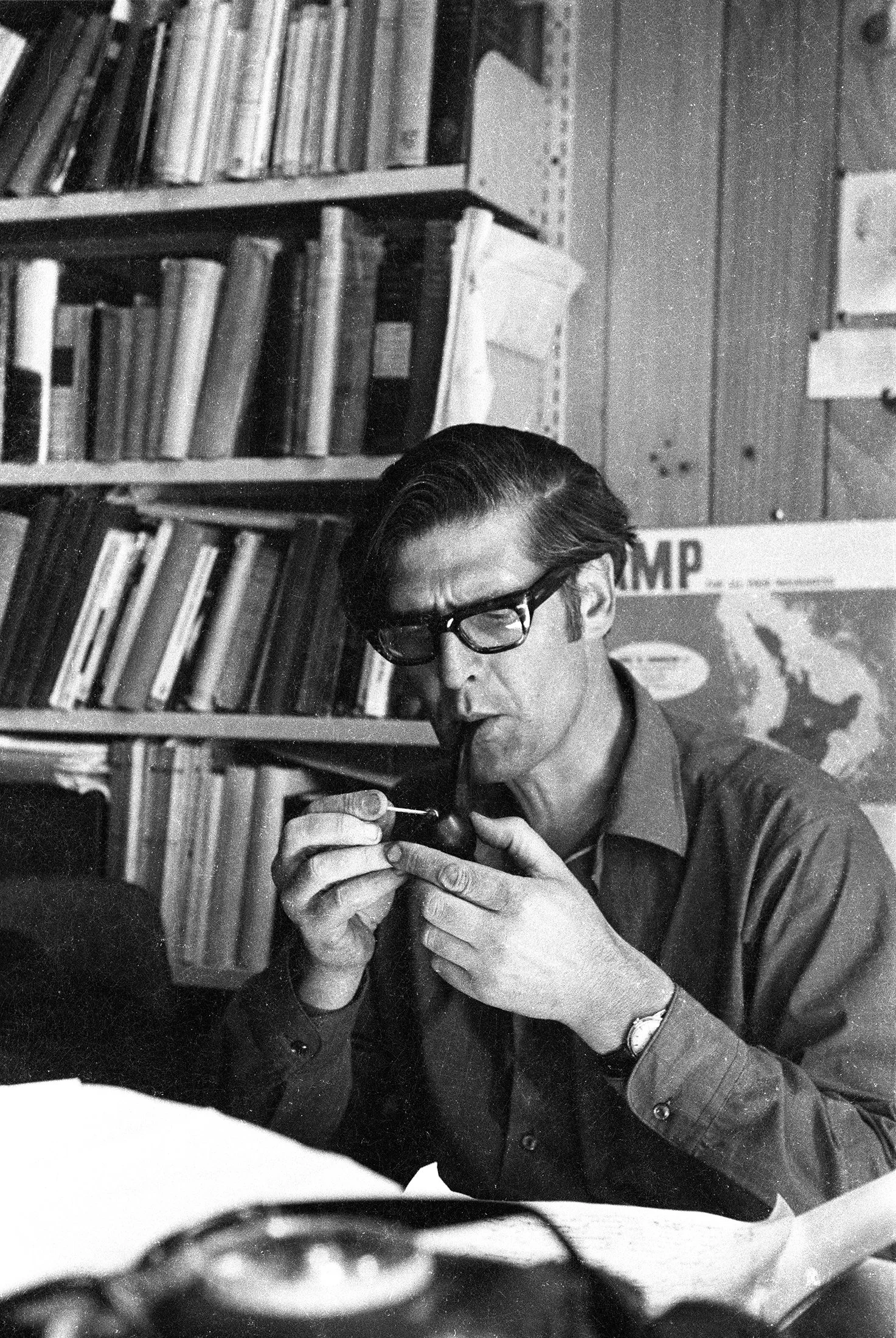
“I probably should have noticed,” says Nick nearly fifty years later, “because he smoked a pipe almost continuously. In just about every photograph I have of him he’s got his bloody pipe. I didn’t even think to ask why he’d stopped, I just said, ‘Was that difficult?’ and he said, ‘It doesn’t seem to be’, and that was that.
“In hindsight, why would he have suddenly given up smoking? He probably had some sort of intimation he wasn’t well. He loved walking in the hills with us kids, and he had asthma, so on walks he’d almost alternate his asthma huffer with his pipe! Now I wonder if that was even asthma, or a congenital heart thing.
“His heart attack came completely out of the blue when Dad was only forty-six, but when I look back there were clues.”
At sixteen Nick was done with the constraints of school, and had been living away from home for about six months by the time his father died. He was eager to get on with life.
“I was young and rebellious and wanted to be out the door to discover the world,” he says.
At the same time, Nick often walked the fifteen-minute climb up through the Wellington Botanic Gardens to spend some time at home, not least for the food. When early one frosty morning, a week after that ‘giving-up-smoking’ conversation, Nick sprinted it.
“I had been asleep when the phone rang about seven o’clock. The sister of one of my flatmates put her head around my bedroom door and said, ‘A girl wants to talk to you and I think she’s a bit upset’. In my groggy state I went to the phone, and it was my sister who said, ‘Dad’s died. He had a heart attack – come now’. It was just a complete… Yeah, it just didn’t make sense. It was a shock.”
Nick didn’t ask questions – he threw on clothes and ran. At home he found his younger sister and brother, fifteen and twelve years old at the time, and an eight-year-old boy the family had fostered. Their mother was away up the Kāpiti Coast with a friend.
“I think Dad had woken my sister and brother up early in the morning and they’d called the family doctor. I met my brother and sister at the door, and then at some point – and I don’t know whether this is five minutes after arriving or an hour after, I really don’t – I went into my parents’ bedroom where dad was, and the doctor was still there with him.
“I sort of backed out of the room. I have this image of seeing the doctor with Dad, I guess he was recording things? We were just stunned. I mean, it was so unexpected, and we were in such unchartered territory.”
A close family friend arrived, and their mother soon after, and Nick says it felt like the doctor then left as quickly as he could. “Maybe he was just staying until another adult turned up? I don’t know. I’m grateful to him for being there, but he definitely wasn’t comforting us.”
To one of Nick’s flatmates, a friend from school, this was not unchartered territory.
“He had lost both his father and mother within a short space of time not long before we’d met him. He was the youngest in quite a big family and had arrived at our school when we were fifteen or sixteen, having been packed off to live with his eldest sister after their parents died. He was a very warm, humorous person and a very good friend to this day, but up until that point I hadn’t thought very much about what an upheaval to his life that must have been. He seemed to be someone who coped very well with adversity.”
This good friend soon turned up with an enormous box of groceries. “The first thing he thought was, ‘They’re going to need food supplies’, and he brought them. He displayed that kindness, empathy, in a very natural way, and it was a mature thing for a teenager to do, so it reminded me, ‘Oh, he’s been through this’. He knew to offer a practical response, whereas a lot of my friends – and many adults – didn’t know what to say or do.”
Those are adults such as a neighbour who arrived the evening of Con’s death. “He turned up on the doorstep, presumably to offer his commiserations, but he was incredibly drunk and incoherent. I had to answer the door to this person while he garbled his words and couldn’t say anything. It was incredibly embarrassing for me, and upsetting.
“Most people who came were wonderful, but you can’t expect teenagers to know what to do in that situation.”
Nor, perhaps, should you instruct a teenager to grab a corner of the stretcher that’s carrying their dad’s body up the steps from their house to the ambulance, as one of the ambulance officers did. So, for Nick, that’s his final memory of his father.
“After that one look when I arrived, I hadn’t gone back in to be with Dad, and no one suggested it. Coming to terms with the irrevocable nature of death can take a while, and certainly this experience consolidated that this was real, that I’ll never see Dad again, but carrying him up to the ambulance was horrible.
“No one asked, ‘Would you mind…?’, it was just, like, ‘Carry this’. It was, I suppose, the first of a series of things that were out of my control.”
Nick says his mother was as blindsided as the kids were, and he imagines she felt “an element of guilt’ for not having been home when it happened. But his parents did not have a conventional marriage and she would often head off for a few days while Con looked after the kids, something he did willingly and loved, much against the expectations of men of his generation.
(As an aside, but a pertinent one, Con’s own father died before he was born and he was brought up by a family of strong women. Consequently, Nick believes, he was serious about being a nurturing, hands-on father, and firmly believed in gender equality.)
While the children and their mother, mostly wordlessly, acknowledged “the enormity of what had happened”, Nick can’t remember if the family sat and talked about what would happen next.
“This is probably jumping ahead a few days, but there was certainly no discussion among us about how we would like the funeral to be. I think this was taken out of our hands. I think for my mother, it was too much for her. She didn’t want to have to organise that. I think she didn’t feel capable.”
Nick says his father’s university colleagues quickly organised a memorial for only two days after Con died. Nick’s conflicted by an awareness and gratitude that the colleagues relieved his blindsided mother of a task she didn’t feel up to, but he’s bemused at how little the funeral ceremony reflected the family.
“The speakers were mostly from Dad’s academic career. There were a couple I knew pretty well from my childhood, and I think they spoke well, but I thought it only partially represented our father. We were almost bystanders. I think we were acknowledged, but there’d been not an iota of consultation that I know of.
“I don’t remember wanting to say anything, although I might have responded differently if someone had asked if I wanted to talk about my dad, if we wanted a particular song played, or whatever. But they didn’t.
“I think the shattering effects of his death were so great we didn’t seem in any shape to have a part in it, and these people were trying to help. On balance they did, but the other side of it was that we had very little to do with the funeral.”
And so their dad’s memorial had very little to do with them. Nick’s suggestion, consequently, is to ask children if they have any suggestions for their parent’s funeral, even if they might seem incapable of an opinion. “Also, it might have been better to have taken a big pause, because I don’t know what the hurry was. He was already cremated – the memorial didn’t have to be so very swiftly done.”
(On a happier note, to mark the 50th anniversary of their father’s death, Nick and his siblings held a memorial service for Con, celebrating and remembering their life “just the way we wanted”, Nick says. “The idea was to do it for our children and grandchildren, none of whom ever had the chance to meet him, but it was cathartic for me and my siblings, too. A hundred or so people, from toddlers to nonagenarians, were there. It was amazing.”)
The year after his father died, Nick moved back into the family home with his fifteen-year-old sister, while their mother moved permanently up to the Kāpiti Coast, taking Nick’s brother and foster brother with her. Various flatmates joined him, and Nick continued “finding out what the world was all about”, now without the security of his dad’s subtle counsel.
Con hadn’t been one to tell Nick what to do, even though Nick had left school with “absolutely no plan”. About the only time Nick can remember his parents “coercing” him into doing anything was when, after high school years (mis)spent watching bands and playing music, they convinced him to sit down and study hard to pass his university entrance exams so he might have the option of further study.
He passed, and after his dad died Nick did give university a go, but when an offer came to tour with a band, as a long-time music nut and bass player Nick dropped out and tuned up. The main lesson young Nick had taken from his father’s death at that time was that “nothing’s permanent, so I might as well live in the moment”. Therefore driving around the country with a band was definitely a great idea.
“Also, the thought of being at university for three years felt incredibly long. That was too much commitment. Whereas playing in a band had no time limit on it – I might do it for the next ten years or I might do it for ten weeks. It felt like the right thing to be doing at that time.
“I carried on living like that for quite a long time. I was very driven by my interest in music, and writing had been a parallel passion right back to primary school. It took me years to get to where I was paid to write about popular music – something I could never have dreamed was possible when I was sixteen.
“I’m sure, if Dad hadn’t died, the years between sixteen and thirty – when I met my life partner and got it together – wouldn’t have been so ad hoc. I can imagine at some point saying to Dad, ‘So, look, I’ve been a postman for the last five years, I’m not sure that’s my life’s work, what do you think I should do?’
“Or he would have at some point quietly said, ‘Look, a much simpler route to doing what you probably want to end up doing would be to do this one-year journalism course, or become a broadcasting cadet’.”
Instead, Nick got to where he is today via a circuitous route, including those years as a postman – a job he loved, by the way. “There was no one to have that conversation with, so I kept trying this and that and doing different things.”
It wasn’t until Nick decided he wanted children that he started thinking about what his father meant to him, and calculating the impact of his death. “I realised it was time to start making decisions on the basis of something that’s going to happen in the future, not just on what feels like the right thing to be doing right now.
“But when you’re young, your life has got this incredible forward trajectory. You’re discovering the world and doing everything for the first time. Everything’s new. You are moving forward through life at an incredible pace, and it’s very hard for anything to make you stop and think.
“My father had died, but I was still charging ahead with life. It was quite a few years before I stopped running, stopped moving, when I realised, ‘Oh, actually, things had changed’. I might have been behaving as if they hadn’t, but a big change had occurred.”
Now a father of three, Nick sees he learned a lot about being a dad from his dad, even though Con never taught anything as a “lesson”.
“Dad treated children as sentient beings, always. If we had something to say at the dinner table, he would listen to us, then he would smile and offer a response. He was interested in our ideas. Dad talked to me from the moment I opened my eyes, and I can remember conversations all the way through those sixteen years with him, different conversations about different things at different stages.
“And jokes – hilarious things he would tell me about his own childhood adventures or some of the colourful characters he knew. We would have kept on having those conversations.
“The predominant feeling I’ve had for the last few decades is that I wish my dad had met my kids. They would have got on really well with him, and he would have really enjoyed them.
“I was incredibly fond of my father. He was a person I always felt absolutely secure with. He was very wise and, when I look back, I did a lot of silly things and there were a lot of times where he would have been going, ‘That’s not a good choice’.
“I probably didn’t articulate it to myself at the time, but at my lowest points I’m sure I was thinking, however inarticulately, ‘I wish my dad was alive. Things would surely be better’. I’d at least have had this wise and experienced and compassionate voice to respond to, to answer my questions.
“But what I’ve realised since is, over the sixteen years I did have him in my life, he provided enough to fill the holes in the following years. It’s amazing how much I know the answer to something because of what my father said once, or that I know what to do because I know what my father would have done.
“I do feel lucky, and I feel sorry for my siblings as they had him for less time.”
Nick is fortunate that, as a writer, his dad jotted down some memories “handwritten and in his own voice”, which Nick discovered years later and published for the family. Also, a producer friend, putting together a documentary on the New Zealand poet James K Baxter, found some video of Con interviewed at Baxter’s tangi – his funeral – and slipped Nick a copy.
The face was instantly recognisable, but the voice on the footage was less familiar.
“It was funny because he talked in a more formal way than I ever remember,” Nick says, laughing. “I thought, ‘Ah, he’s doing that for the camera’. It was his broadcast voice, which is what you were expected to do in those days. That was a beautiful thing to find.”
Story by Lee-Anne Duncan